Chimney inspection · Seattle

Chimney inspection in Seattle

Not sure whether you need a quick look or a full camera inspection — we scope it before we climb the roof.

No obligation. Someone answers every day, 7 a.m. to 9 p.m.

  • A Level 1 visual check runs about thirty minutes; a full Level 2 camera inspection runs closer to an hour.
  • A written condition report naming the level performed and everything it found.
  • For a Level 2, clear access to the attic or crawlspace if either exists.
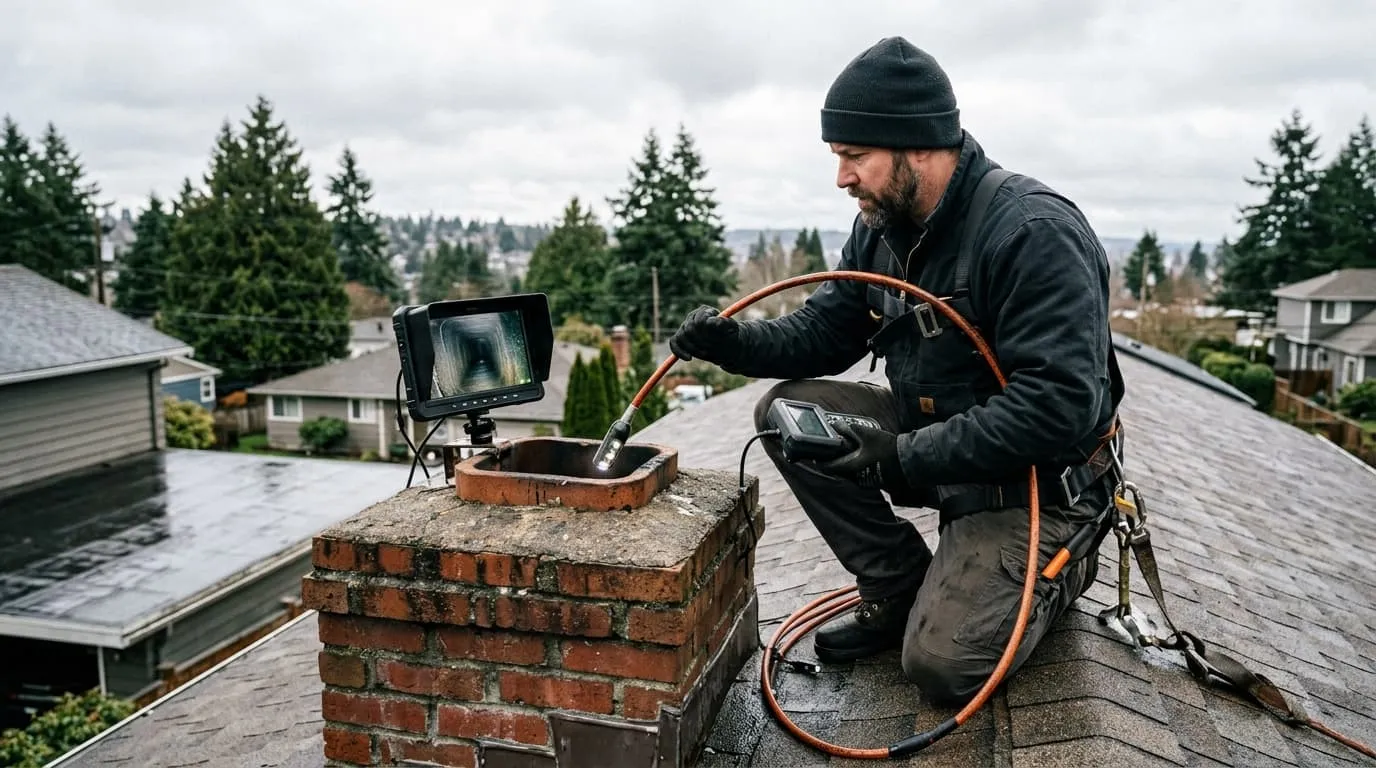
An inspection camera on a flexible rod being fed into a chimney flue, monitor screen visible

Inspection levels

What each level actually checks

Cap, crown, liner and mortar — the components an inspection reviews, and how deep each level goes.

The short answer

A chimney inspection is a condition review, and NFPA 211 defines three depths of it. A Level 1 inspection covers what is visible without a camera or ladder, right for a chimney under continued, unchanged use. A Level 2 goes further, with a video camera down the flue and a check of accessible attic, crawlspace and roof areas — the inspection most Seattle real-estate transactions ask for at a change of ownership, and the one to book after adding or swapping an appliance. A Level 3 is the deepest, called for when there is reason to think the structure itself may be compromised — after an earthquake, a lightning strike, or visible structural damage — and can involve opening a concealed section to see what is actually there. We tell you which level your situation actually calls for before we book it, not the most expensive option by default.

Cutaway of a masonry chimney: the cap and spark arrestor at the top, then the crown, the flue liner running down inside the brickwork, the mortar joints, the flashing where the stack meets the roof, the smoke chamber, and the firebox down at the hearth.01020304050607
  1. 01Cap and spark arrestor Keeps rain, fir needles and nesting birds out of the flue. Washington’s fire code sets what the mesh has to be.
  2. 02Crown The sloped slab across the top. Moss holds water against it for months here, and water is what opens the first crack.
  3. 03Flue liner The passage the smoke leaves by. A break in it is a safety fault, not a maintenance item.
  4. 04Mortar joints Once the crown lets water past, these wash out from the inside, where nobody is looking.
  5. 05Flashing The seam between stack and roof. More wet ceilings start at this seam than anywhere else on the chimney.
  6. 06Smoke chamber The shelf a flue brush never reaches. When a house smells of last winter, this is usually where it is coming from.
  7. 07Firebox The only part of the whole system most people ever see — and the last place a problem turns up.

Book this if

The usual reasons to call

  • A house sale is pending and the buyer’s agent has asked for a chimney inspection.
  • You just bought the house and have no record of when the chimney was last serviced.
  • An earthquake, wind storm or lightning strike happened and you want the chimney checked before using it again.
  • You are switching appliances — a wood insert to gas, for instance — and need the flue confirmed for the new fuel.

Not sure which level fits? Call (206) 866-2929 and describe the situation — we will scope the right one.

What is included

Inspection, scoped plainly

Included

  • The correct NFPA 211 inspection level for your stated situation
  • A written condition report you keep, not just a verbal summary
  • Camera footage of the flue interior on a Level 2 or Level 3 inspection
  • A plain-language walkthrough of every finding before we leave

Not included

  • Any repair work the inspection identifies — quoted separately so the inspection stays an honest, independent assessment
  • Destructive opening of finished walls or ceilings on a Level 3, unless you approve it in advance

Any repair an inspection turns up is quoted separately, so the inspection itself stays an honest, independent assessment.

The visit

How an inspection goes

  1. 1

    Scope the level

    We confirm which level actually fits your situation before anything else — sale, appliance change, storm damage or routine use all call for a different depth.

  2. 2

    Visual and camera pass

    For a Level 2, a video camera runs the length of the flue while a technician checks the exterior, the crown and every joint by eye.

  3. 3

    Attic and crawlspace check

    Where the chimney passes through an attic or crawlspace, we check clearances to combustibles and look for water staining or gaps.

  4. 4

    Written report

    Every finding — structural or cosmetic — goes into a written report you keep, with photos from the camera pass where relevant.

  5. 5

    Plain-language recap

    Before we leave, we walk through what the report says in plain terms, and what, if anything, is worth addressing and on what timeline.

An inspection camera on a flexible rod being fed into a chimney flue, monitor screen visible

Inspection levels, defined

Inspection levels, defined

Three depths of inspection, each with a specific trigger — set by the same national standard every reputable chimney company is measured against.

Level 1
Visual check, no camera — annual use, unchanged system
Level 2
Video camera, plus attic/crawlspace — sale, appliance change
Level 3
Concealed-area access — after damage or a suspected structural issue
Camera used
Level 2 and Level 3 only
Typical Level 2 length
60–90 minutes

NFPA 211: Standard for Chimneys, Fireplaces, Vents, and Solid Fuel-Burning Appliances, Level 1–3 definitions.

In detail

Three levels, one national standard

Why a real-estate sale, a new appliance and an earthquake each call for a different depth of check.

01Three levels, one standard

“Chimney inspection” covers three genuinely different services, and NFPA 211 — the standard the whole industry works from — is specific about which one fits which situation.

Continue reading

A Level 1 inspection is the annual check: a visual review of everything reachable without a camera or a ladder to the roof, right for a chimney under continued, unchanged use with nothing unusual to report. A Level 2 goes further, adding a video camera run down the full length of the flue plus a check of accessible attic, crawlspace and roof areas, and it is the depth called for whenever ownership changes, an appliance is added or swapped, or the system’s use otherwise changes. A Level 3 is the most involved of the three, reserved for situations where the structure itself may be compromised — after an earthquake, a lightning strike, a chimney fire, or visible structural damage — and can include opening a concealed section of the chimney or the surrounding structure to see what a camera cannot.

02Why Seattle transactions usually ask for a Level 2

A home sale is the single most common reason we get a call for an inspection, and it is almost always a Level 2 that satisfies it.

Continue reading

Buyers, agents and lenders want to know the flue itself is sound, not just that the firebox looks clean, and a camera run the length of the liner is the only way to actually confirm that without opening the wall. We schedule these with sale timelines in mind and turn the written report around quickly, because a pending closing rarely has room to wait.

03When a Level 3 is the right call

The deepest inspection level exists for a narrower set of circumstances, and Seattle sits in a place where those circumstances are not hypothetical.

Continue reading

The region carries real seismic exposure from both the shallow Seattle Fault, which runs directly beneath the city, and the deeper Cascadia subduction zone offshore — and brick chimneys are consistently among the first things to show damage when the ground moves. If a chimney has been through an earthquake, a lightning strike, or shows a lean, a gap at the roofline or a crack that looks like it might run deeper than the surface, that is a Level 3 situation: cameras and visual checks alone cannot always confirm what is happening inside a masonry structure that may have shifted.

04What the report actually gives you

Every inspection, at every level, ends with something in writing — not just a verbal “looks fine” on the way out the door.

Continue reading

The report names the level performed, documents what was checked, and records every finding, minor or major, with camera photos attached wherever a Level 2 or Level 3 camera pass was part of the job. That written record is what a buyer’s agent, an insurer or your own future self will actually want to see, and it is yours to keep regardless of whether you act on anything it recommends.

05What an inspection does not do

An inspection is a diagnosis, not a repair, and we keep those two things separate on purpose.

Continue reading

The same technician who inspects a chimney can absolutely do the repair work it turns up, but the inspection itself is priced and reported independently of any recommendation that follows it — nothing about what we find changes what the inspection costs or how thoroughly we report it. That separation is what makes the written report something you can actually trust for a sale, an insurance claim or your own records, rather than a sales pitch dressed up as a condition check.

06Booking the right level the first time

Tell us why you are calling — a pending sale, a new appliance, storm or earthquake concern, or just a chimney nobody has looked at in years — and we will recommend the inspection level that actually fits rather than defaulting to the most thorough one.

Continue reading

We work every day from 7 a.m. to 9 p.m. across a twenty-mile radius from central Seattle, and a Level 2 inspection for a sale is one call away.

Reviews

What the last 41 customers actually said

5.0

41 Google reviewscounted 2026-08-25

  • 541
  • 40
  • 30
  • 20
  • 10
  • Anthony Gill

    Water started dripping into our attic during heavy rain so we knew the chimney needed attention fast. Team showed up prepared and diagnosed a completely eroded concrete crown and pulled-away flashing. …
  • Gregory Phillips

    Moved into a new-to-us house in Ballard with a gorgeous brick fireplace but no service history. Scheduled an inspection to be safe. …
  • Loretta Green

    It was important to us to feel safe about our tall chimney after the recent earthquake. The crew carefully checked it out from the inside and the roof. They found some loose cement joints and a crown that was slightly off-center. …
  • Leona Green

    The tech was sweeping the roof from the top down and took images revealing a damaged chimney crown and weak mortar joints on the chase. Clear visual proof, no hard sell!

Read all 41 reviews on Google

Questions

What people ask about inspections

Which inspection level do I need to sell my house in Seattle?

Most Seattle transactions ask for a Level 2 — the standard NFPA 211 calls for at any change of ownership. It includes a camera pass down the flue and a check of accessible attic and crawlspace areas.

Do I need an inspection after an earthquake even if nothing looks damaged?

NFPA 211 calls for a Level 3 inspection whenever an event like an earthquake may have affected the chimney, specifically because damage to a masonry stack is not always visible from the ground.

How long does a chimney inspection take?

A Level 1 visual check runs about thirty minutes. A full Level 2 with the camera and attic access typically takes closer to an hour.

Will you tell me if I only need the cheaper inspection?

Yes — we scope the level based on what you tell us about the situation, not the other way around, and we will say plainly if a Level 1 covers what you actually need.

Do you provide a written report I can give to a buyer or an insurer?

Yes, every inspection level comes with a written report, and a Level 2 or Level 3 includes camera photos where relevant.

Book an inspection

Tell us why you are calling — a sale, a new appliance, storm damage — and we will scope the right level.

Or call (206) 866-2929 to book directly.

Tell us what changed.

Tell us what the fireplace is doing and what changed. Someone reads every message that comes in.

No obligation. Someone answers every day, 7 a.m. to 9 p.m.

Prefer to talk? Call (206) 866-2929, every day from 7 a.m. to 9 p.m.