Chimney caps · Seattle

Chimney caps and spark arrestors in Seattle

A missing cap seems minor until it is the reason water, birds or embers got in — this is the fix that stops it.

No obligation. Someone answers every day, 7 a.m. to 9 p.m.

  • Most single-flue cap installations finish in under an hour.
  • A stainless cap and mesh sized correctly to your flue’s net free area.
  • A roof-level fit check before we call the job done.
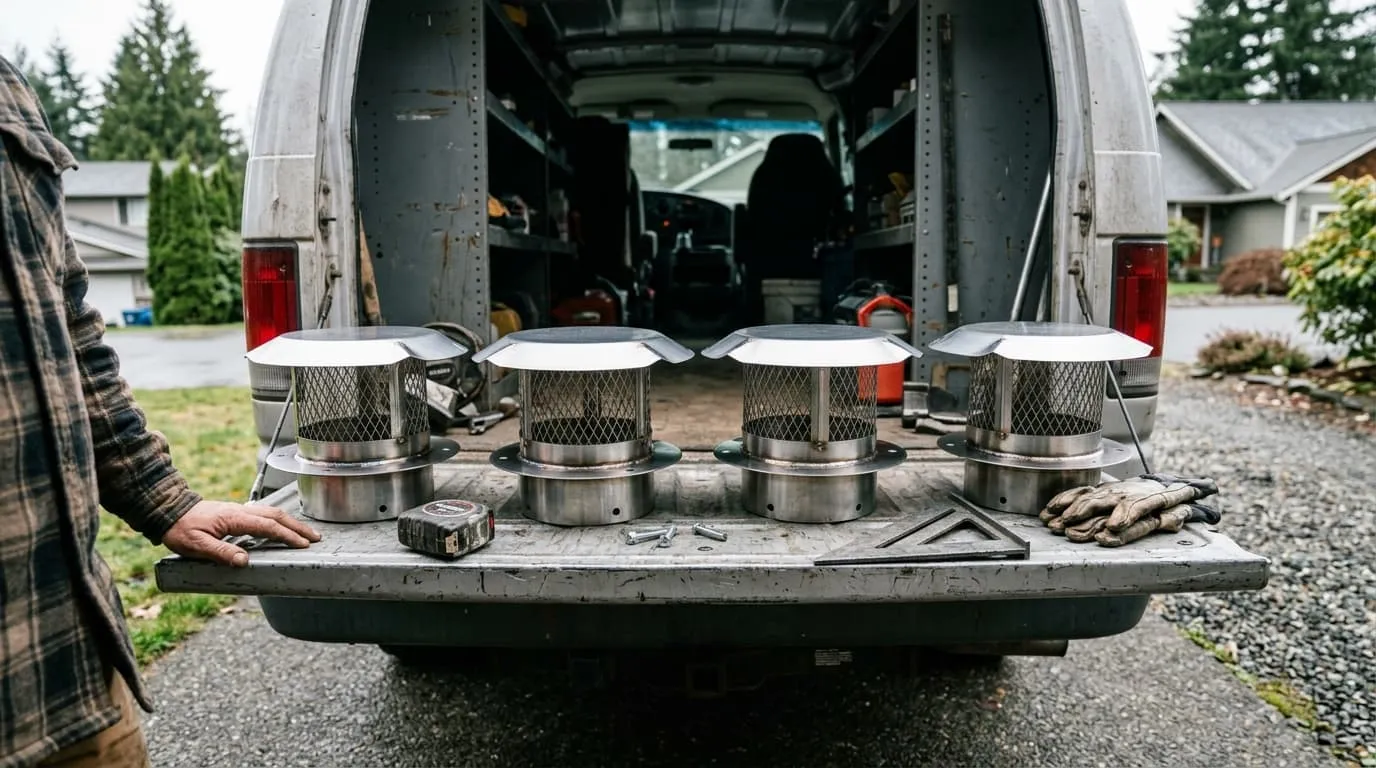
Several new stainless steel chimney caps with mesh spark-arrestor screens laid out on a work surface before installation

What a cap does

One part, three jobs

Rain, animals and embers — the cap sitting at the top of the flue handles all three at once.

The short answer

A chimney cap is a small piece of stainless steel doing several jobs at once: keeping rain out of the flue, stopping birds and small animals from nesting in it, and containing sparks and embers so they cannot land on a wood-shake or composition roof nearby. Washington’s fire code, based on the International Fire Code, sets real specifications for the spark-arrestor mesh on a masonry chimney — net free area at least four times the flue opening, mesh openings between three-eighths and one-half inch, and corrosion resistance equal to 19-gauge galvanized or 24-gauge stainless steel. On a factory-built, metal-chase fireplace system, the cap has to be the exact model listed for that system to keep its manufacturer listing intact. We fit the correct cap for whichever kind of chimney you have, not a universal part that happens to cover the opening.

Cutaway of a masonry chimney: the cap and spark arrestor at the top, then the crown, the flue liner running down inside the brickwork, the mortar joints, the flashing where the stack meets the roof, the smoke chamber, and the firebox down at the hearth.01020304050607
  1. 01Cap and spark arrestor Keeps rain, fir needles and nesting birds out of the flue. Washington’s fire code sets what the mesh has to be.
  2. 02Crown The sloped slab across the top. Moss holds water against it for months here, and water is what opens the first crack.
  3. 03Flue liner The passage the smoke leaves by. A break in it is a safety fault, not a maintenance item.
  4. 04Mortar joints Once the crown lets water past, these wash out from the inside, where nobody is looking.
  5. 05Flashing The seam between stack and roof. More wet ceilings start at this seam than anywhere else on the chimney.
  6. 06Smoke chamber The shelf a flue brush never reaches. When a house smells of last winter, this is usually where it is coming from.
  7. 07Firebox The only part of the whole system most people ever see — and the last place a problem turns up.

Book this if you noticed

The usual signs

  • No cap at all, or a rusted-through one that no longer closes the flue properly.
  • Birds, leaves or nesting material coming down the flue.
  • A metal-chase fireplace with a cap that does not match the original manufacturer’s model.
  • Visible daylight or gaps around the current cap where it meets the flue.

Not sure if your cap fits code, or fits a factory-built system? Call (206) 866-2929 and we will confirm.

What is included

Cap installation, scoped plainly

Included

  • A stainless steel cap with spark-arrestor mesh sized to code for your flue
  • Removal and disposal of the old or failed cap
  • Manufacturer-matched caps for factory-built, metal-chase systems
  • A roof-level check of the surrounding flashing while we are already there

Not included

  • Crown or mortar repair — a cracked crown under a new cap still leaks, and gets quoted as its own repair
  • Multi-flue custom cap fabrication for irregular chimney shapes, which we scope separately

A cracked crown underneath a new cap still leaks — that gets quoted as its own repair if we find it.

The visit

How a cap installation goes

  1. 1

    Measure the flue

    We measure the exact flue opening so the replacement cap’s net free area meets code rather than guessing at a standard size.

  2. 2

    Confirm the system type

    Masonry and factory-built systems take different caps — we confirm which one your chimney is before ordering or fitting a part.

  3. 3

    Remove the old cap

    Any failed or missing cap is removed and the flue opening is cleared and checked before the new one goes on.

  4. 4

    Fit and seal

    The new stainless cap is fitted, seated and sealed to the flue, with the mesh checked for full coverage.

  5. 5

    Roof-level check

    We confirm the fit and check surrounding flashing while we are already at roof level, at no extra cost for the look.

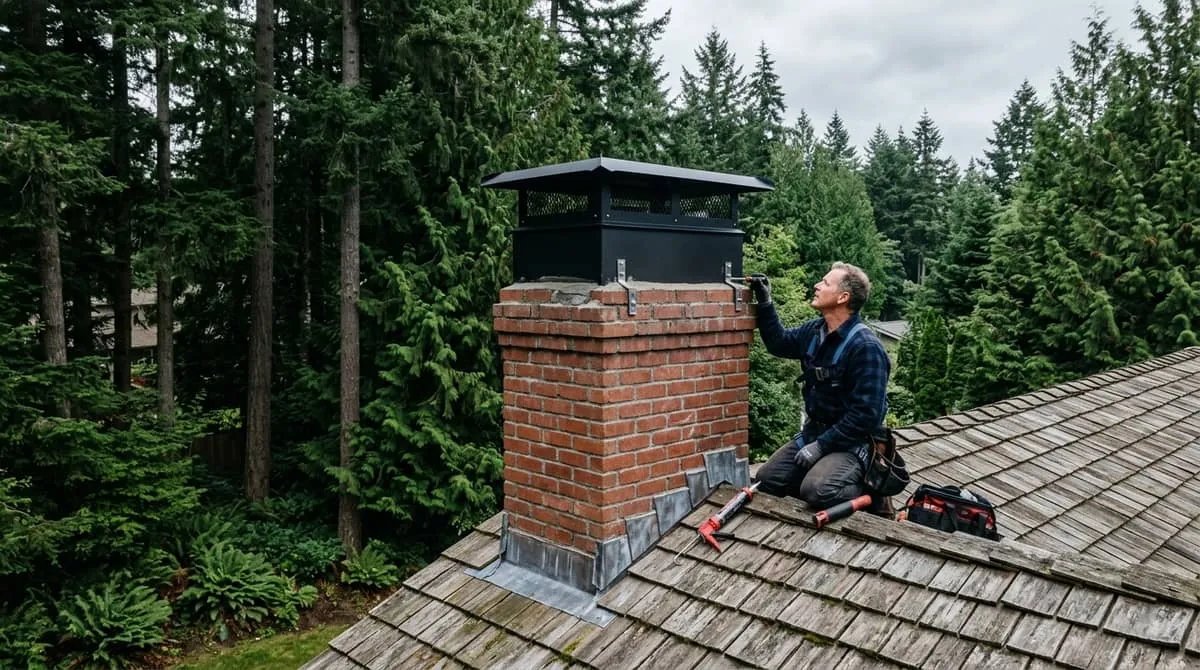
A newly installed black chimney cap on a brick chimney on a cedar shingle roof surrounded by tall fir trees

Cap specifications

Cap specifications

The code requirements a spark-arrestor cap on a masonry chimney is actually held to in Washington State, spelled out plainly.

Net free area
At least 4× the flue’s net free area
Mesh opening size
3/8 in. to 1/2 in.
Corrosion resistance
19-gauge galvanized steel or 24-gauge stainless
Accessibility
Removable for flue cleaning, per code
Factory-built systems
Cap model must match the manufacturer’s listing

Washington State Fire Code, based on the 2021 International Fire Code, spark-arrestor provisions.

In detail

Why the right cap depends on the chimney underneath it

Masonry and factory-built systems take genuinely different parts — here is how to tell which one you have.

01The smallest part with the biggest job

A chimney cap sits at the very top of the system and does more work per square inch than almost anything else on the house: it sheds rain away from the flue opening, its mesh screen stops birds, squirrels and raccoons from treating an open flue as a nesting site, and — where it doubles as a spark arrestor — it contains embers so they cannot drift onto a nearby roof.

Continue reading

On a wood-shake or composition-shingle roof, which is most of what Seattle and King County are built with, that ember containment is not a decorative feature. It is the reason spark arrestors are written into fire code at all.

02What Washington’s code actually specifies

Washington’s fire code, built on the International Fire Code, does not leave a spark arrestor’s specifications to guesswork.

Continue reading

Where one is installed on a masonry chimney, the open area left by the mesh, once the wire itself is discounted, has to come to four times the flue opening or more — undersizing the mesh restricts draft and can push smoke back into the room. The mesh openings themselves have to fall between three-eighths and one-half inch: small enough to stop embers and animals, large enough not to clog with creosote and choke the draft. The screen material has to resist heat and corrosion to a standard equal to 19-gauge galvanized steel or 24-gauge stainless, and the whole assembly has to stay removable, because the code also requires that the flue underneath remain accessible for cleaning.

03Masonry and factory-built systems take different caps

Not every chimney in our service area is brick. A large share of newer construction across Redmond, parts of Bellevue and other tract-built neighborhoods runs factory-built, zero-clearance fireplace systems inside a framed metal chase, and those systems are only certified as a matched set — firebox, flue pipe and cap all tested together and listed under UL 103.

Continue reading

Fitting a universal or masonry-style cap onto a factory-built chimney can void that listing, and with it, in some cases, the coverage a homeowner’s insurance policy assumes is in place. We confirm which kind of system is on the roof before ordering a part, and for a factory-built chimney, that means sourcing the model the manufacturer actually lists for it.

04Why this is the repair that prevents the next one

A missing or failed cap does not just let weather in — it accelerates almost every other kind of chimney damage on this site.

Continue reading

Rain reaching an unprotected flue opening is what keeps a crown wet longer after every storm, which is a large part of what drives the cracking that eventually needs a full crown repair. Needles and moss collect faster on an exposed crown than a capped one. Birds and debris in an unprotected flue restrict draft and, in the worst cases, block it outright. A cap replacement is a small job next to a crown rebuild or a full repointing — and a large part of preventing either from becoming necessary sooner than it should.

05What we check before we climb the ladder

Not every cap job is a straightforward swap. A chimney with more than one flue needs a cap sized and matched to each opening individually, since combining flues under one cap can affect draft on both.

Continue reading

A chimney that has never had a cap at all sometimes has an opening that is not a standard size, which we measure rather than assume. And a cap that failed early — corroded through in a few years instead of lasting decades — is often a sign the crown underneath is already letting water sit against the metal from below, which is worth mentioning before we fit the replacement rather than after.

06Booking a cap or spark-arrestor installation

Tell us whether your fireplace is a brick masonry chimney or a factory-built system in a metal chase, and whether you know the manufacturer if it is the latter — that lets us bring the right part on the first visit rather than a second trip.

Continue reading

Most single-flue installations finish in under an hour. We work every day from 7 a.m. to 9 p.m. across a twenty-mile radius from central Seattle.

Reviews

What the last 41 customers actually said

5.0

41 Google reviewscounted 2026-08-25

  • 541
  • 40
  • 30
  • 20
  • 10
  • Anthony Gill

    Water started dripping into our attic during heavy rain so we knew the chimney needed attention fast. Team showed up prepared and diagnosed a completely eroded concrete crown and pulled-away flashing. …
  • Gregory Phillips

    Moved into a new-to-us house in Ballard with a gorgeous brick fireplace but no service history. Scheduled an inspection to be safe. …
  • Loretta Green

    It was important to us to feel safe about our tall chimney after the recent earthquake. The crew carefully checked it out from the inside and the roof. They found some loose cement joints and a crown that was slightly off-center. …
  • Leona Green

    The tech was sweeping the roof from the top down and took images revealing a damaged chimney crown and weak mortar joints on the chase. Clear visual proof, no hard sell!

Read all 41 reviews on Google

Questions

What people ask about caps

Does Washington actually require a spark arrestor on a chimney?

Washington’s fire code, based on the International Fire Code, sets specific requirements for a spark-arrestor cap where one is installed — mesh opening size, net free area and corrosion resistance are all defined rather than left to guesswork.

Can I put any chimney cap on my factory-built fireplace?

No. A factory-built system needs the cap model listed for that specific system to keep the manufacturer’s UL listing — and often your homeowner’s insurance coverage — intact. We match the model rather than fitting a universal part.

How do I know if my current cap is too small or too large?

Code sets the mesh’s net free area at a minimum of four times the flue’s own opening. We measure the flue directly rather than assuming a standard size fits, since an undersized cap restricts draft and can cause smoke problems.

Does a cap really stop moss and water damage?

A cap alone will not fix a cracked crown, but it substantially reduces the water and debris load reaching the crown in the first place, which is a large part of what causes that cracking over time in a wet climate like Seattle’s.

Book a cap installation

Tell us whether your fireplace is masonry or factory-built, if you know — we will bring the right part.

Or call (206) 866-2929 to book directly.

Tell us what changed.

Tell us what the fireplace is doing and what changed. Someone reads every message that comes in.

No obligation. Someone answers every day, 7 a.m. to 9 p.m.

Prefer to talk? Call (206) 866-2929, every day from 7 a.m. to 9 p.m.