Spark arrestor rules in Washington State
Washington’s fire code sets specific, checkable requirements for a chimney spark arrestor. Here is exactly what the code says, why each number is what it is, and what it means when a cap gets replaced.
Published
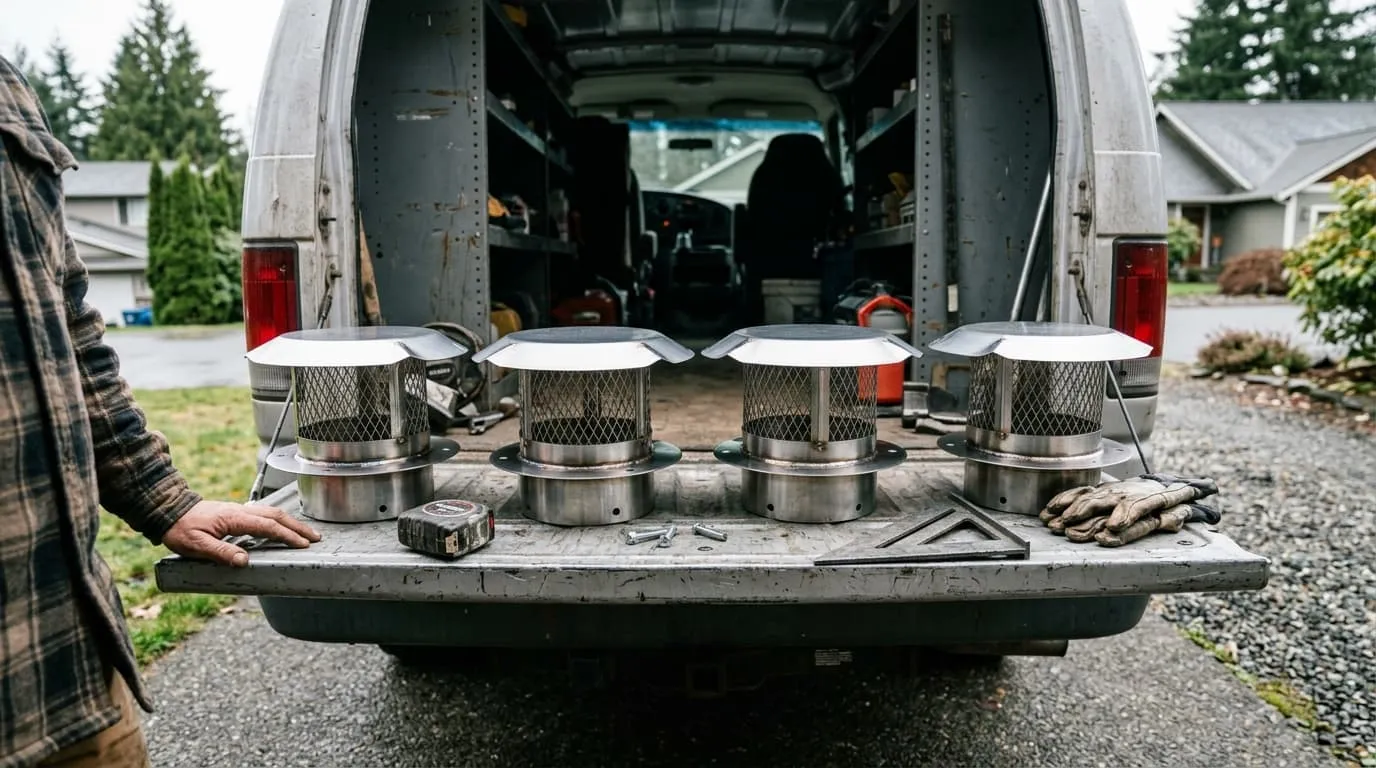
A spark arrestor is a small piece of hardware — a mesh screen fitted at the top of a chimney flue — but it is one of the few chimney components with a genuinely specific, codified set of requirements behind it, rather than general good practice. Washington’s fire code, adopted from the International Fire Code, spells out exactly what a spark arrestor has to be. Most homeowners never read that code directly, so here is what it actually says, translated out of code language.
What a spark arrestor is actually for
A spark arrestor’s job is exactly what its name says: stopping sparks and embers carried up the flue by a fire’s draft from exiting the chimney and landing somewhere they could ignite something else. On a wood-shake roof, a composition-shingle roof near dry vegetation, or simply a roof adjacent to any combustible material, an ember escaping an unscreened flue opening is a real ignition source, not a theoretical one. The same mesh screen typically doubles as protection against rain, birds and small animals entering the flue, which is why “chimney cap” and “spark arrestor” often refer to the same physical part, even though the cap’s rain-shedding shape and the arrestor’s mesh screen are technically two separate functions built into one assembly.
The code’s actual requirements, one at a time
Where a spark arrestor is installed on a masonry chimney, Washington’s fire code sets four specific requirements.
Net free area. The arrestor’s net free area — the total open area through the mesh once you account for the material blocking part of it — has to come to four times the opening of the flue it sits over, or more. This is not an arbitrary safety margin. A mesh screen with too little open area restricts the draft passing through it, which can push smoke back into the room and, worse, create the kind of backpressure that lets combustion byproducts build up inside the flue instead of exhausting properly. The four-times multiplier is what keeps a spark-stopping screen from becoming a draft problem in its own right.
Mesh opening size. The individual openings in the mesh have to measure no more than one-half inch across, and no less than three-eighths of an inch. The upper bound is what actually stops sparks and embers — anything larger and the mesh simply is not doing its job. The lower bound exists for a different reason: mesh with openings smaller than three-eighths of an inch clogs with creosote and debris far faster, turning a safety feature into a maintenance problem and, eventually, a draft-restricting one.
Corrosion resistance. The screen material has to provide heat and corrosion resistance equivalent to 19-gauge galvanized steel or 24-gauge stainless steel. In a climate like Seattle’s, with roughly 150 wet days a year and near-constant humidity even on the dry days, corrosion resistance is not a minor spec — a screen that rusts through in a few years stops doing its job long before anyone notices, because a partially corroded screen still looks intact from the ground.
Accessibility. The code also requires that the arrestor assembly remain removable, specifically so the flue underneath it can still be cleaned. A cap that is welded, riveted or otherwise permanently fixed in place fails this requirement even if the mesh itself meets every other spec, because it turns routine chimney sweeping into a job that requires disassembling the cap first.
Masonry versus factory-built: a different set of rules entirely
Everything above describes the requirement for a spark arrestor fitted to a masonry chimney. A factory-built, zero-clearance fireplace system — the kind installed in a large share of newer King County construction, particularly across Redmond and other post-1970s tract development — operates under a different framework entirely. Those systems are tested and listed as a complete assembly under UL 103, meaning the firebox, the flue pipe and the termination cap are all certified together as a matched set. Fitting a generic, code-compliant masonry-style spark arrestor onto a factory-built system does not necessarily satisfy the requirement for that system — it needs the cap specifically listed by the manufacturer for that model, because the whole point of the UL 103 listing is that the components were tested together, not independently.
This distinction trips people up more than any other part of the spark-arrestor conversation. A cap that is perfectly code-compliant in isolation can still be the wrong cap for a specific factory-built chimney, and installing it can void both the manufacturer’s warranty and, in some cases, a homeowner’s insurance coverage that assumes the listed system remains intact.
What this means when a cap gets replaced
In practice, the code requirements above are exactly what a properly fitted replacement cap is measured against. On a masonry chimney, that means measuring the actual flue opening rather than assuming a standard size fits, selecting mesh with the correct opening range, and confirming the material’s corrosion rating before installation — not just picking whatever cap looks close enough at a hardware store. On a factory-built system, it means identifying the manufacturer and model first, and sourcing the matched part rather than a universal substitute.
Why this is worth getting right the first time
A spark arrestor is inexpensive relative to almost every other chimney component, and it is also one of the most consequential from a fire-safety standpoint — it is the one part of the system whose entire job is preventing an ignition source from leaving the chimney in the first place. Getting the mesh size, net free area and material spec right is not a matter of code-compliance box-checking; it is the difference between a part that actually does its job for years and one that looks the part while quietly failing at it. If it has been years since anyone confirmed what is actually installed on a chimney’s flue opening, that is a quick, inexpensive thing to check — and a straightforward one to correct if it turns out to be undersized, oversized, or simply the wrong cap for the system underneath it.
Read next
More from the blog
Moss, debris and why caps fail early here
A chimney cap in Seattle or King County works under a load most of the country never deals with: near-constant shade, moisture and needle litter from evergreen canopy. Here is why that shortens a cap’s working life, and what actually helps.
Burn bans in the Puget Sound region, and what they mean for your fireplace
A burn ban restricts using a fireplace or wood stove during poor air quality — it does not restrict having one serviced. Here is what Stage 1 and Stage 2 actually mean, who qualifies for an exemption, and how to keep a wood-burning fireplace ready for the days you can use it.
When chimney work in Seattle needs a permit
Repointing a chimney with no structural change usually needs no permit in Seattle. Work touching a load-bearing support or the building envelope needs one regardless of cost. Here is where that line actually falls.
Get a code-correct cap fitted
Tell us whether your chimney is masonry or factory-built and we will bring the right part.